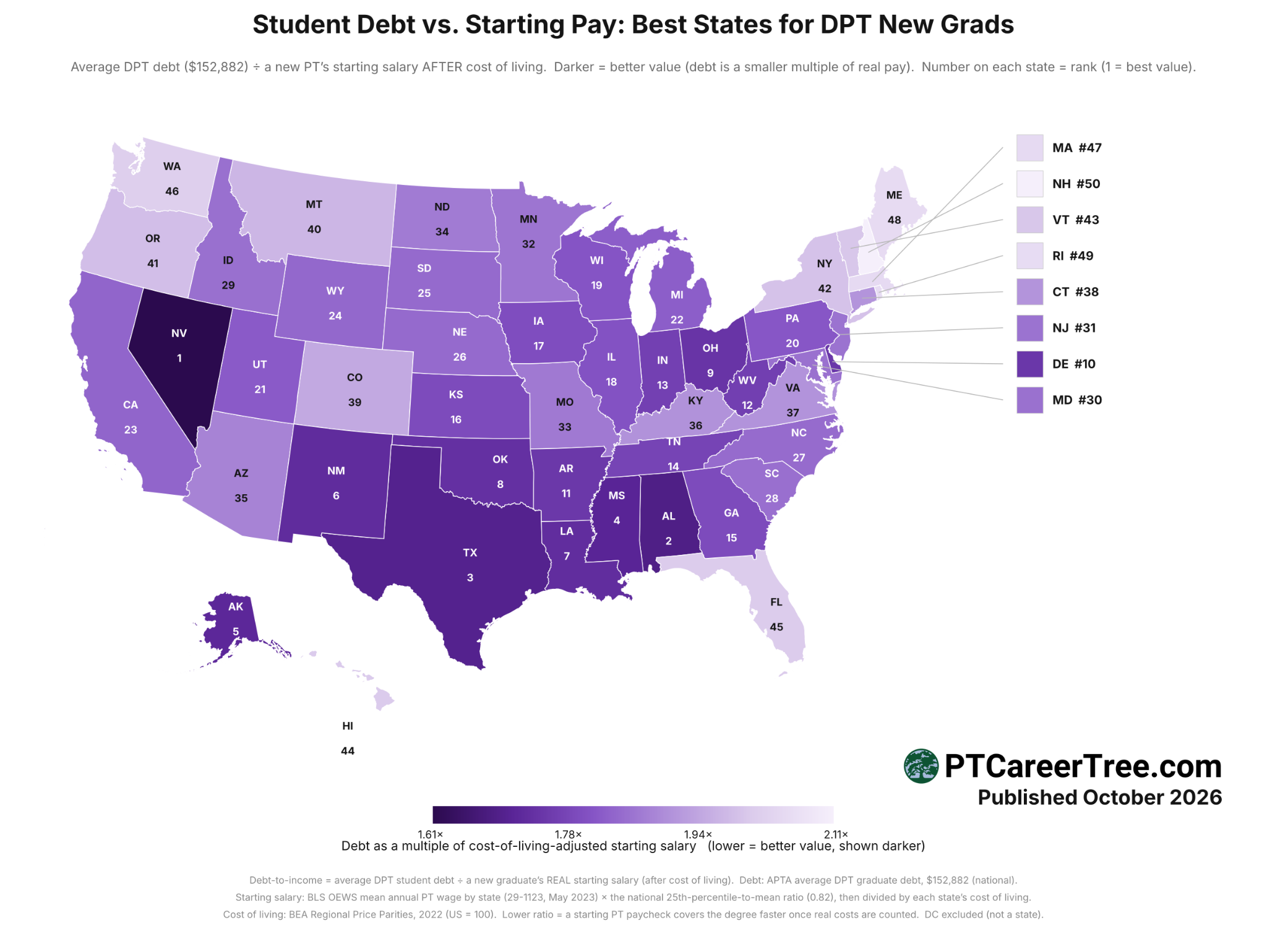
The best-paying state for a new Physical Therapist isn’t the best place to start your career. Not even close. For the many DPT grads who finish school with student loans — the average borrower owes around $152,882 (APTA June 2020) — what matters isn’t the salary on the offer letter. It’s how fast that salary actually pays the debt down.
And the answer is not where you’d guess.
California pays new PTs some of the highest salaries in the country. But once you account for what it costs to actually live there, California drops to the middle of the pack — 23rd. New Jersey, another high-salary state, falls to 31st. The expensive coasts look great on a salary offer and far worse on a bank statement.
Where a DPT pays off fastest. After adjusting starting pay for cost of living, the best-value states are Nevada, Alabama, Texas, Mississippi, and Alaska. These are places where PT salaries are solid and the cost of living is low — so a starting paycheck covers more of the degree, faster. Much of the South and Mountain West follows close behind.
Where it’s toughest. At the bottom sit the high-cost states where a good-looking salary gets eaten alive: New Hampshire, Rhode Island, Maine, Massachusetts, Washington, and Hawaii. A new grad who borrowed carries the same loan but has less real income left to attack it.
Why this matters. A job offer in a big coastal city can look like the obvious win. But for a new PT carrying six figures of student debt, the smarter financial move is often a market where the dollar stretches. The salary number on the offer letter tells you half the story; cost of living tells you the rest.
How we built it. We took the APTA’s average debt among DPT graduates who borrow from a report published in June 2020 ($152,882) as a common yardstick, divided it by each state’s entry-level PT salary (BLS wage data), then adjusted that salary for cost of living using the Bureau of Economic Analysis Regional Price Parities. The result is a debt-to-income multiple — how many years of a real starting paycheck that typical loan represents. It’s a benchmark for borrowers, not a claim that every grad carries this debt. Lower is better.
Physical therapists only. A planning estimate, not a guarantee of pay.