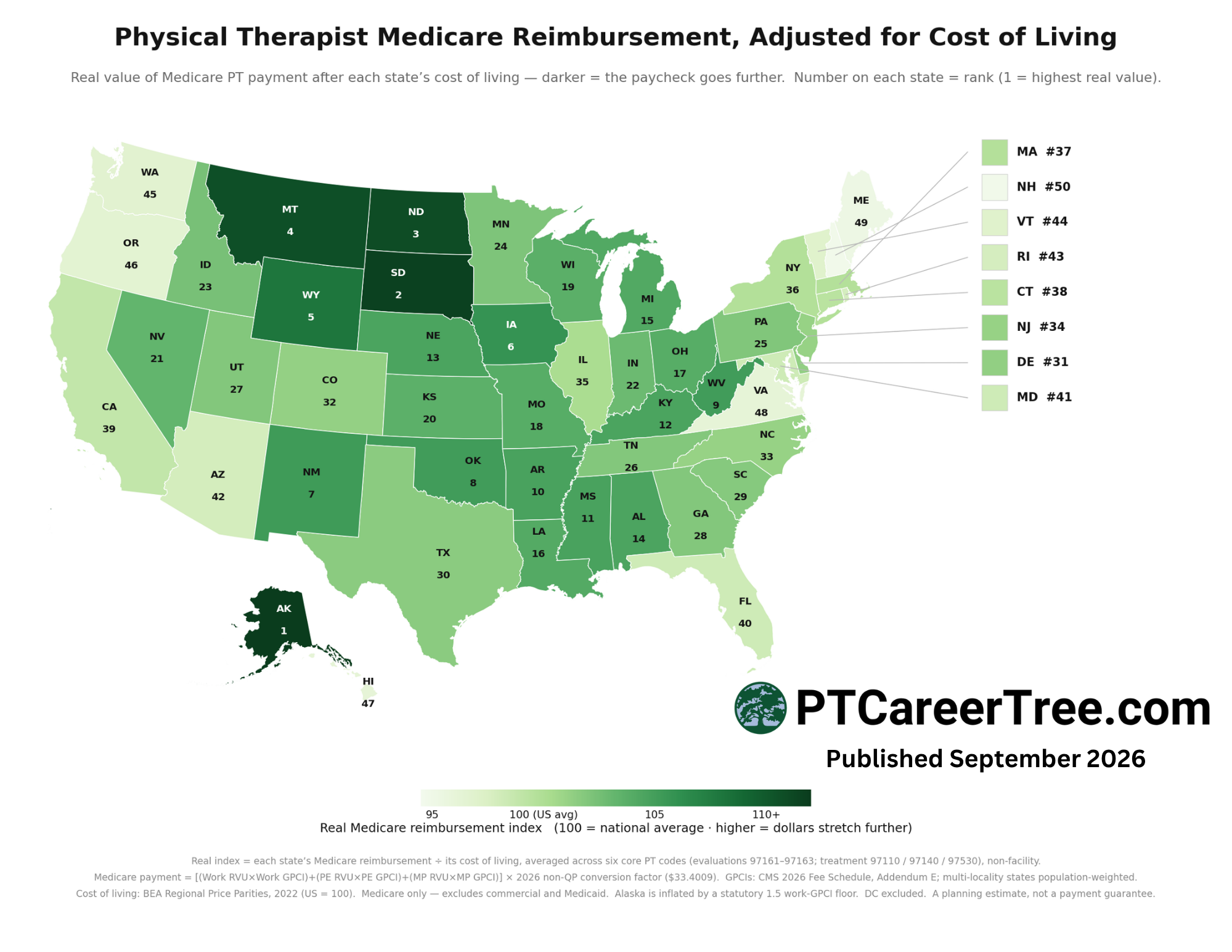
On paper, Medicare pays physical therapists more in California and New York than in Arkansas or South Dakota. But once you account for what a dollar actually buys in each state, that map flips.
Medicare already adjusts payments by location through the Geographic Practice Cost Index (GPCI). The catch: the GPCI under-shoots real cost of living almost everywhere. So the states where Medicare reimbursement goes furthest aren't the high-cost coasts — they're lower-cost interior states.
Where the dollar stretches furthest. After the cost-of-living adjustment, the top of the ranking is Alaska (a special case — see below), then the low-cost interior: South Dakota, North Dakota, Montana, Wyoming, Iowa, New Mexico, Oklahoma, West Virginia, and Arkansas. At the bottom sit the high-cost states, where nominally higher pay gets eaten by expenses: New Hampshire, Maine, Virginia, Hawaii, Oregon, Washington, and California. Alaska ranks first only because a statutory 1.5 work-GPCI floor over-pays it relative to its moderate cost of living.
How we built the map. For each state, we calculated Medicare's 2026 non-facility payment for six core PT codes — the three evaluation tiers (97161–97163) plus the most-billed treatment codes (97110, 97140, 97530) — using the standard formula: [(Work RVU × Work GPCI) + (PE RVU × PE GPCI) + (MP RVU × MP GPCI)] × the 2026 conversion factor ($33.4009). GPCIs come from CMS's 2026 Physician Fee Schedule (Addendum E), with multi-locality states population-weighted. We then divided each state's reimbursement by its cost of living using the Bureau of Economic Analysis Regional Price Parities (RPPs) — the official federal measure of state price levels, indexed to a U.S. average of 100 (2022 values) — producing a "real" index where 100 equals national purchasing power. Darker green means the paycheck goes further.
Why it matters. For a PT choosing where to practice — and for clinic owners weighing where the Medicare math actually works — nominal reimbursement tells only half the story. On a real, cost-adjusted basis, lower-cost markets often come out ahead.
Medicare only; commercial and Medicaid rates follow separate schedules. Figures are a planning estimate, not a guarantee of payment.