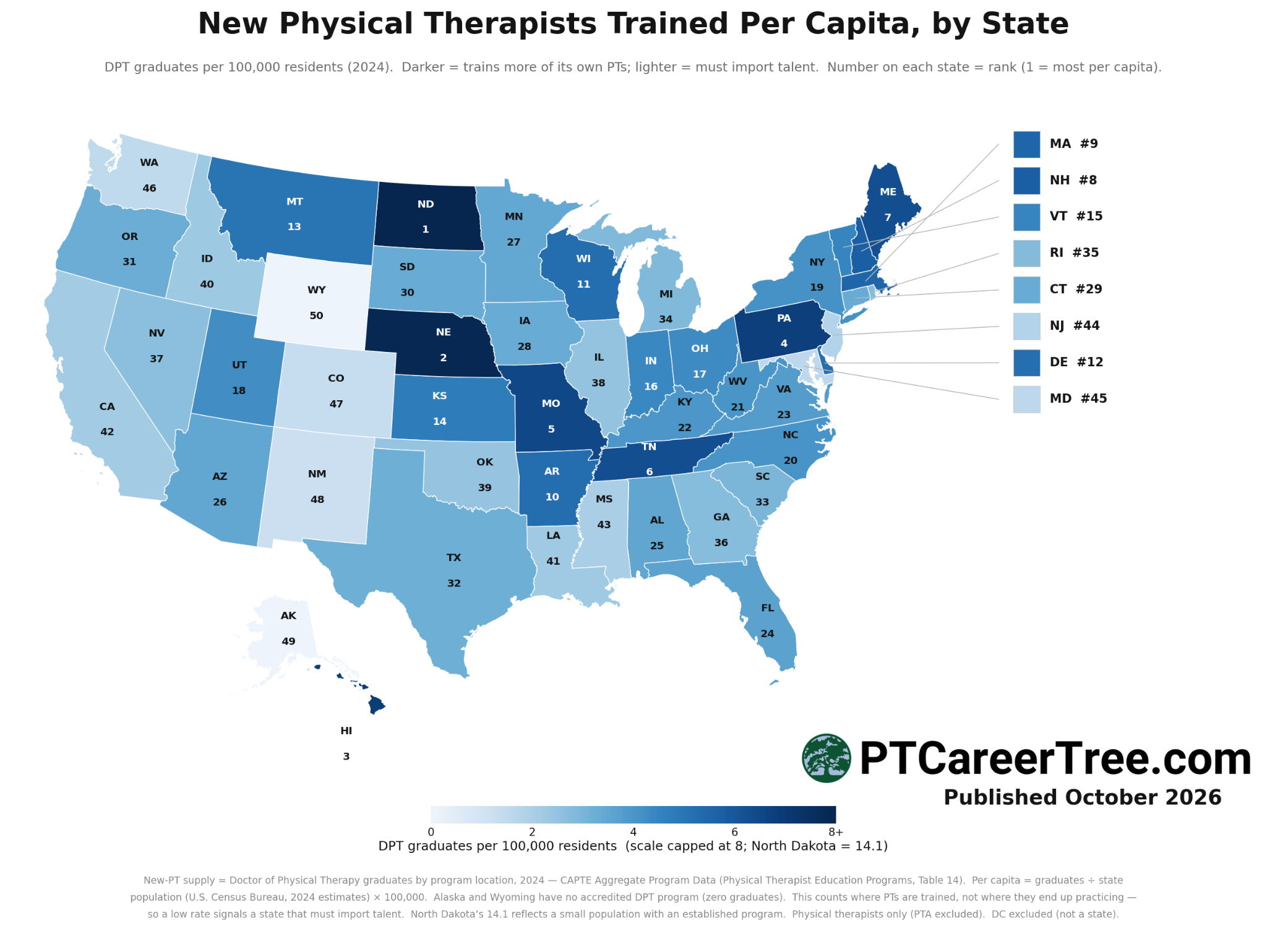
Every state needs Physical Therapists. Not every state trains them.
We mapped where new PTs actually come from: Doctor of Physical Therapy graduates per 100,000 residents, using CAPTE's 2024 program data. The gap between states is wider than most people expect, and it tells you exactly where hiring is hardest.
The states that supply their own. North Dakota leads the country, graduating 14.1 new PTs per 100,000 residents, followed by Nebraska, Hawaii, Pennsylvania, Missouri, and Tennessee. These states run established programs relative to their population, so local employers have a steady home-grown pipeline to draw from.
The states that have to import talent. At the other end, Wyoming and Alaska train zero new PTs. They have no accredited DPT program at all. Close behind sit New Mexico, Colorado, Maryland, New Jersey, and Washington. And here's the part that surprises people: the biggest states produce the fewest PTs relative to their size. California trains just 2.2 per 100,000, Texas 3.2, and Florida 3.6. Their raw graduate numbers are large, but nowhere near enough to cover their populations.
Why it matters. When a state trains few PTs for its size, local employers can't simply grow their own. They compete for talent that has to come from somewhere else. For clinics in those markets, out-of-state recruiting isn't a nice-to-have; it's the only way to staff up. Pair this with demand and the sharpest opportunities are the states that are both short on PTs and training few new ones.
A few notes on the method: this counts where PTs are trained, not where they end up practicing, since new grads can be mobile. North Dakota's high rate reflects a small population with a long-standing program. Figures are Physical Therapists only; PTAs are excluded.
Source: CAPTE 2024 Aggregate Program Data (DPT graduates by state); U.S. Census Bureau 2024 population estimates.