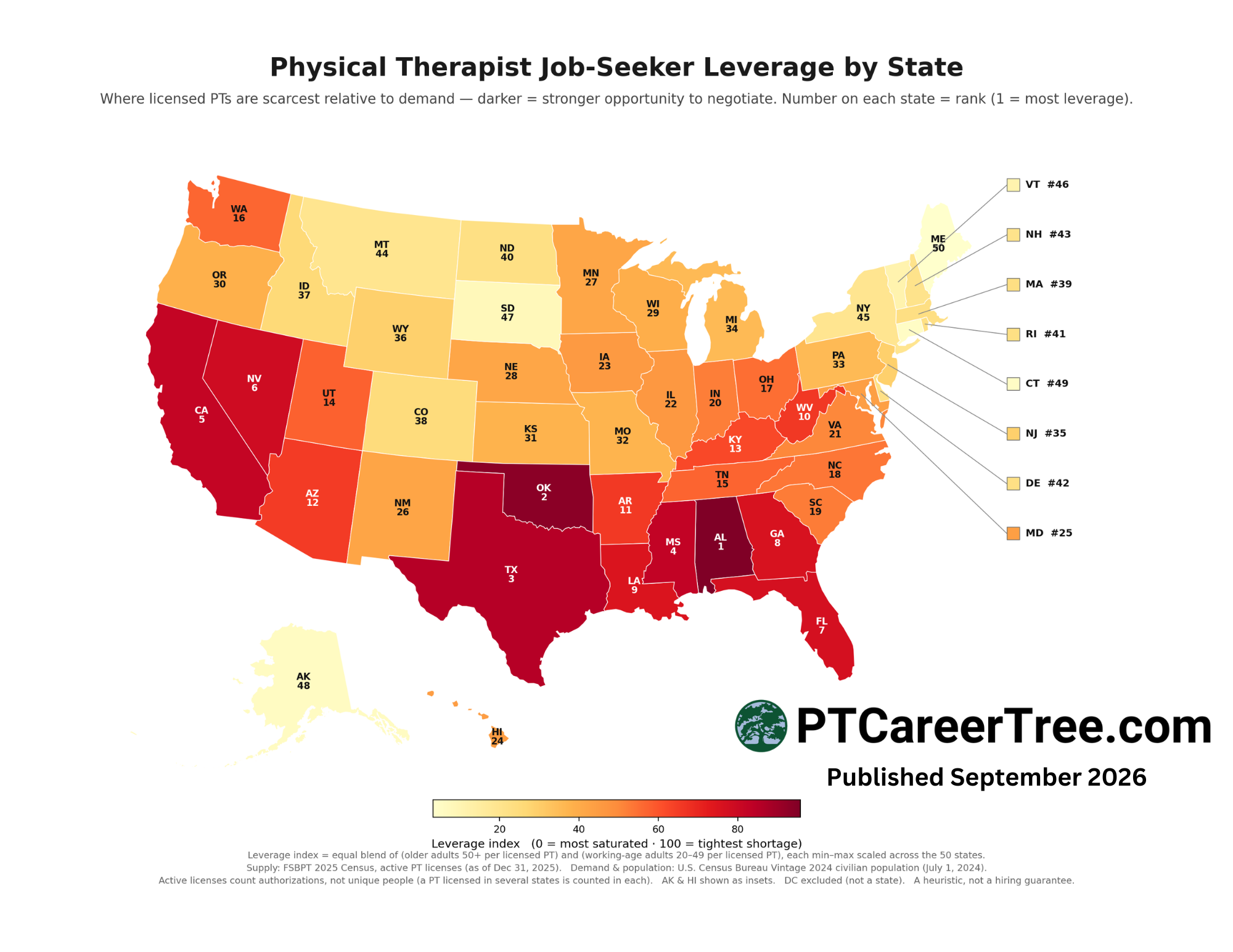
Where are Physical Therapists in the strongest position when searching for a new job?
This map looks at PT job-seeker leverage across all 50 states by comparing the supply of licensed Physical Therapists with factors that influence demand for PT services. Darker states represent a greater shortage of licensed PTs relative to the estimated demand, suggesting a stronger environment for job seekers to negotiate compensation, flexibility, and other employment terms.
The results show substantial differences across the country. States such as Alabama, Mississippi, Oklahoma, Texas, and California rank toward the high-leverage end of the scale, while states including Vermont, Connecticut, Maine, and Massachusetts rank lower.
How was the map created?
The leverage index uses an equal blend of three measures:
- The percentage of the population age 50 and older
- Licensed PTs per 10,000 residents
- Estimated demand/population factors
Each measure was min-max scaled across the 50 states and combined into a single index from 0–100. The states were then ranked, with #1 representing the highest relative job-seeker leverage.
The analysis uses the FSBPT 2025 Census of active PT licenses and U.S. Census Bureau 2024 population data. Importantly, active licenses represent license authorizations—not necessarily unique individuals—because a PT licensed in multiple states can be counted more than once.
This isn't a prediction of hiring outcomes for an individual PT. Local labor markets, specialty, experience, setting, compensation, and individual employer demand can all significantly affect a job seeker's actual leverage.
For employers, the map offers another way to think about recruitment difficulty. For PTs, it highlights where the broader labor market may provide more room to evaluate opportunities and negotiate.
A quick note on Alaska
Alaska is an important example of why this data should be viewed as a high-level indicator rather than a definitive measure of job-seeker leverage. The analysis relies on active PT licensure data, and those counts can include therapists who hold licenses in multiple states.
Alaska has a particularly unique dynamic because many Physical Therapists obtain an Alaska license to work there temporarily as travel therapists, without intending to relocate permanently.
As a result, the number of licensed PTs in Alaska may overstate the size of the permanent local workforce. While the data places Alaska toward the lower end of the leverage scale, a PT seeking a permanent position in Alaska may actually have considerably more leverage, depending on the geographic area and practice setting. The distinction between having a state license and actually being part of the permanent local workforce is important when interpreting the results.